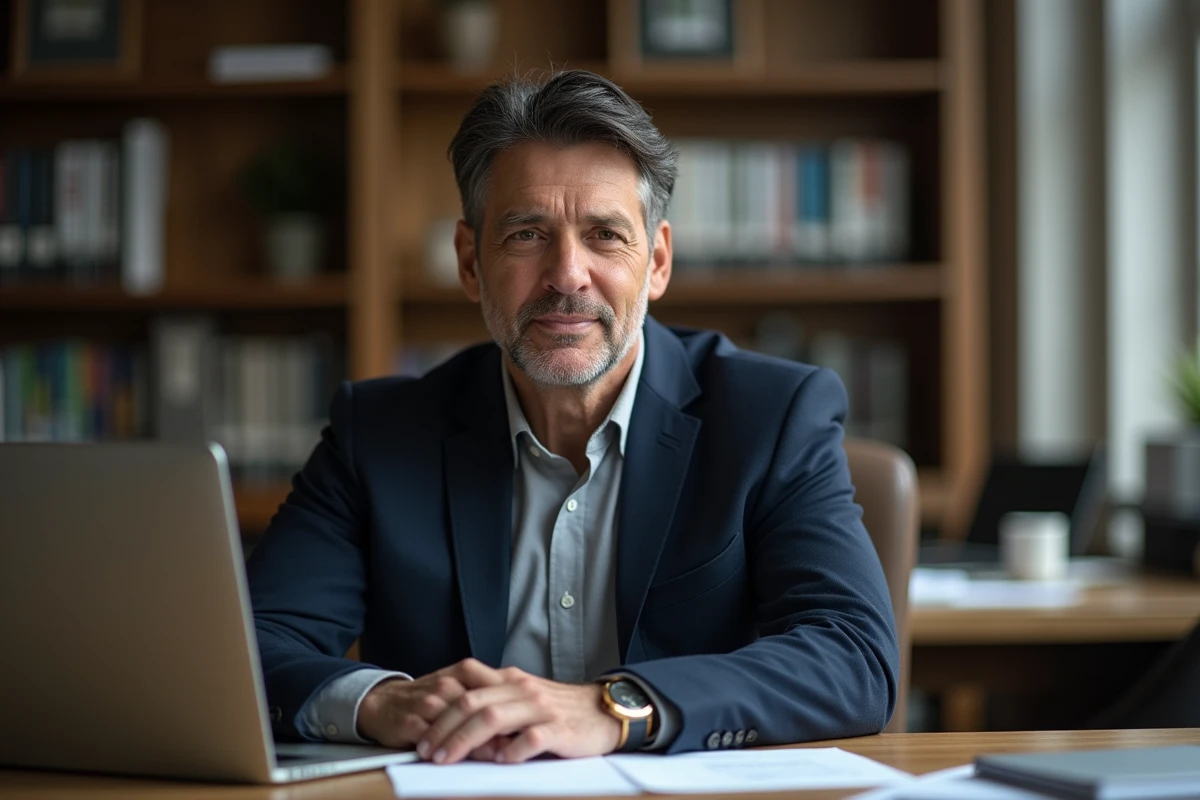
Bruno Jeudy is one of those figures in French political journalism whose face is familiar, but whose private life remains opaque. Born on September 26, 1963, in Château-Gontier, he has passed through the most influential newsrooms in the country without ever letting details about his marital life slip out. This discretion, in a media landscape where personal exposure has become the norm, raises questions about the boundaries between the public and private spheres for political commentators.
Discretion of the Jeudy-Lévy couple in the face of social media
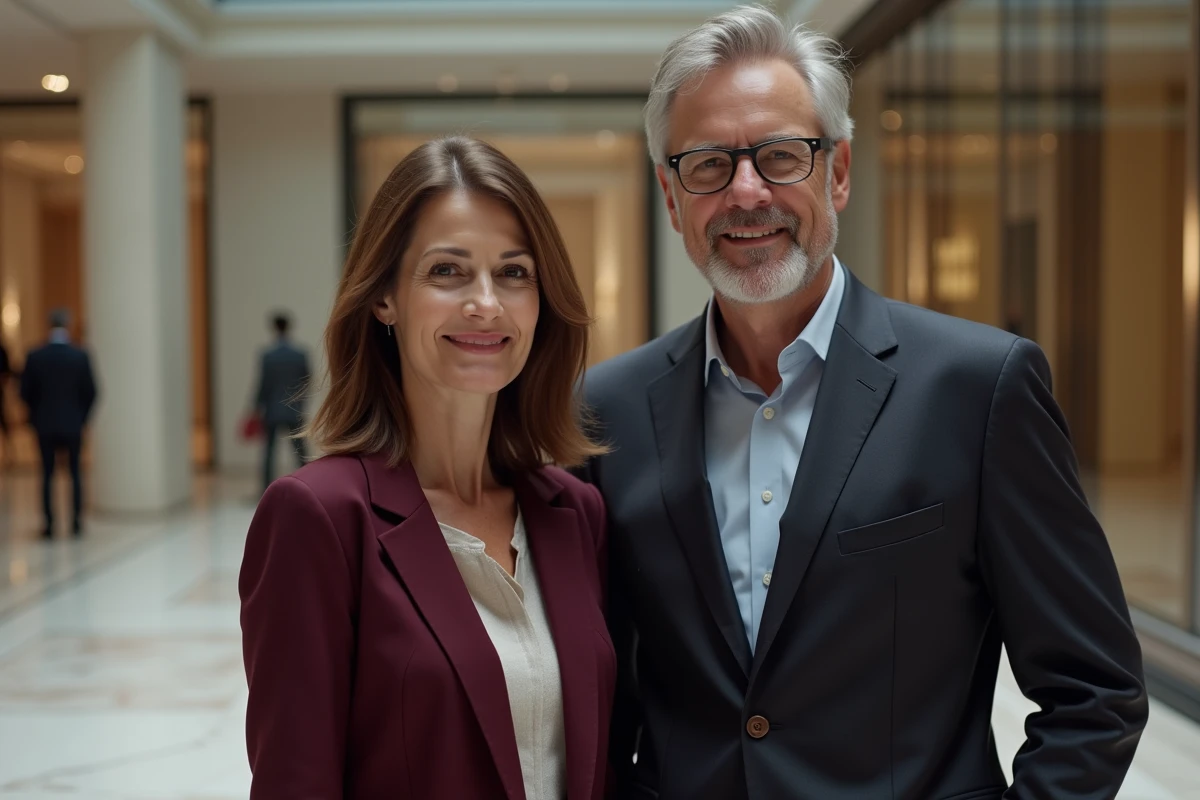
Bruno Jeudy is not active on social media in the way most media personalities are. No vacation photos, no family stories, no couple snapshots. His partner, Nathalie Lévy, a journalist herself, adopts a similar stance by maintaining a clear separation between her professional life and her personal daily life.
This choice of withdrawal raises questions in an era where transparency is often seen as a guarantee of sincerity. For a political commentator who comments on the communication strategies of elected officials, this digital absence can be interpreted in two ways. It first protects against apparent conflicts of interest: no one can accuse the couple of mingling with certain circles of power based on social media posts.
On the other hand, this opacity can also fuel curiosity and speculation. Several sites have launched articles attempting to reconstruct parts of Bruno Jeudy’s private life and that of his partner, with often contradictory results. Some sources mention a wife named Laurence, while others identify Nathalie Lévy as his partner. The available data does not allow for a definitive conclusion about the timeline of these relationships.
Nathalie Lévy: journalistic career and personal commitment
Nathalie Lévy is a French journalist with a documented television career. She has worked on several news channels and has built a reputation independent of that of Bruno Jeudy.
A lesser-known aspect of her life concerns her role as a family caregiver for her grandmother until her passing. This experience inspired her book Courage au coeur et sac au dos, published in 2021. The book addresses the daily reality of supporting a dependent loved one, a topic rarely covered by French media figures.
This book reveals an intimate side that Nathalie Lévy has chosen to make public on her own terms, not through a social network, but through structured editorial work. The approach illustrates a precise conception of the boundary between private life and public expression: what is shared passes through the filter of writing and reflection, not through that of digital immediacy.
Bruno Jeudy from Ouest-France to La Tribune Dimanche
Understanding Bruno Jeudy’s discretion also involves examining his professional background, which reveals a trajectory built over time rather than on visibility.
- He began in 1987 at Ouest-France after studying at the University of Nantes (Bachelor’s in Geography) and then at the University of Angers (Master’s in Economic and Social Administration) and a DESS in Information and Communication at the University Paris II.
- He then worked at Le Parisien, Le Figaro, and then at Journal du Dimanche, where he served as political editor.
- From 2015 to 2022, he was the political editor of Paris Match. His departure in 2022 followed a major editorial disagreement over the magazine’s direction.
- Since 2016, he has appeared as a commentator on BFMTV and took the helm of the La Tribune Dimanche project in 2023.
This journey in print media, first regional and then national, partly explains his professional culture. Journalists trained in the print newsrooms of the 1980s and 1990s did not grow up with the obligation to showcase themselves. Competence was demonstrated through articles, not by the number of followers.
Journalistic credibility and transparency: a fragile balance
The question raised by the Jeudy-Lévy couple goes beyond their own situation. It touches on a broader debate about what the public is entitled to expect from political journalists regarding personal transparency.
On one hand, total discretion can serve as a professional shield. A commentator who reveals nothing about their private life limits potential angles of attack regarding possible biases. They also preserve the distinction between political commentary, which falls under analysis, and the personality of the one producing it.
On the other hand, the phenomenon of “journalist couples” close to power has sparked recurring criticism in the French public debate. The absence of transparency does not equate to a lack of connections, and some observers believe that discretion can mask problematic proximities with the political circles being covered.
Bruno Jeudy has published several works on French politics, covering figures like Nicolas Sarkozy or the internal dynamics of parties. These books represent a form of assumed editorial commitment, contrasting with the silence regarding his private sphere. The journalist chooses to make his analyses public, not his personal associations.
What Bruno Jeudy’s departure from Paris Match reveals
The editorial conflict that led Bruno Jeudy to leave Paris Match in 2022 sheds light on another aspect of his stance. Leaving such a prestigious title over a fundamental disagreement implies a demanding conception of editorial independence. This choice preceded his involvement in launching La Tribune Dimanche, a project that has given him more editorial latitude.
Leaving a position rather than compromising on editorial direction is an act that carries more weight, in terms of credibility, than any Instagram post. Perhaps this is where the coherence of the character lies: personal discretion is not an image calculation, but an extension of a conception of the profession where only published work matters.
The Jeudy-Lévy couple embodies an approach to political journalism that refuses to confuse media notoriety with intimate exposure. Whether this stance can survive in the age of social media, where even the most serious commentators eventually succumb to the temptation of behind-the-scenes selfies, remains an open question. Field feedback varies on this point: some colleagues see it as a model, while others view it as an anachronism.