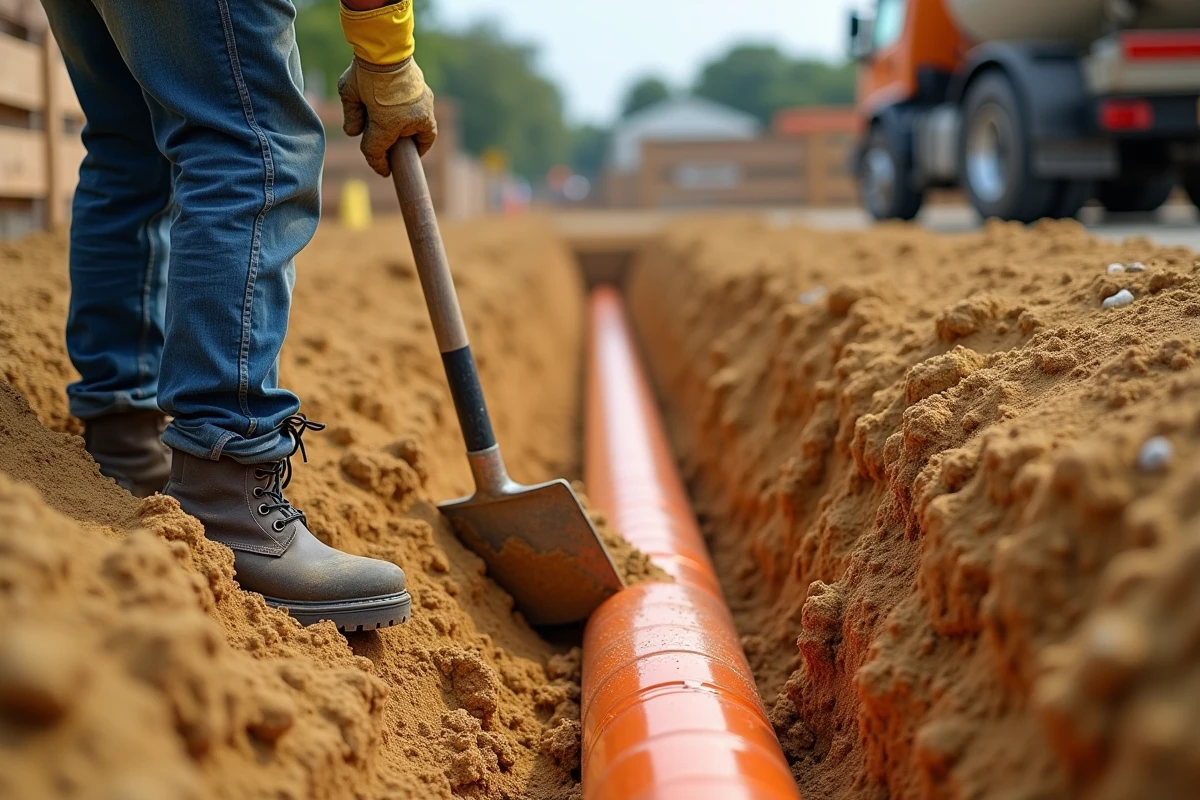
The sand used around buried pipelines is not just simple fill. It serves as a coating material whose role is to absorb the mechanical stresses exerted by the soil on the pipes, while ensuring uniform support beneath the pipe. Without this calibrated layer, a single stone or differential settlement is enough to crack a PVC pipe or dislodge a joint.
Grain Size of Sand for Pipelines: What the Standard Requires
The NF EN 1610 standard, whose current version was confirmed in 2023 by Afnor, regulates the installation and testing of sanitation networks. It requires that the bedding and coating material be a clean, fine aggregate, free of frost-sensitive or organic elements, with controlled granularity.
In practice, specifications most often require sand of type 0/4 (rolled or crushed and graded). Some project owners accept 0/6 or 0/10 for large diameter pipes, but the trend is towards tightening the requirements. The technical guide “Sanitation Networks” (Technical Editions of Sanitation, reissue 2022) explicitly prohibits uncontrolled recovered backfill.
Before deciding to use sand for pipelines on a construction site, it is essential to check the product sheet from the supplier and ensure that the grain size matches the specifications of the relevant network (drinking water, wastewater, or stormwater).
For PVC, cast iron, or PE pipes, crushed quarry sand 3/6 remains a common reference on VRD sites. For concrete pipes, the trench bottom must be stable and free of stones that could cause puncturing.
Bedding and Coating: Two Distinct Functions on the Site
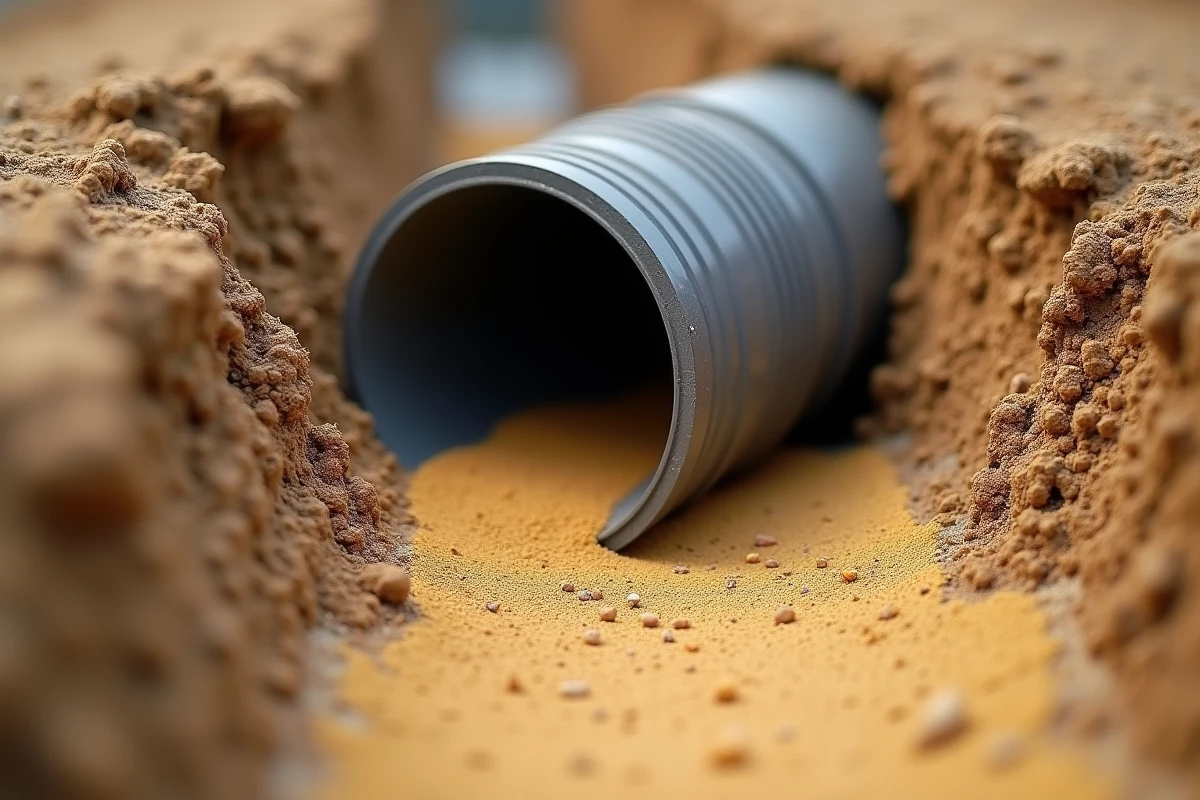
The bedding and coating are often confused. The bedding refers to the layer of sand placed at the bottom of the trench, under the lower generator of the pipe. The coating, on the other hand, covers the pipe up to a defined height above its upper generator.
The Bedding: Continuous Support Under the Pipeline
Its normative thickness is a minimum of 10 cm under the lower generator of the pipeline. This bedding must be perfectly leveled and compacted by hand, not with a roller, to conform to the curvature of the pipe without creating hard points.
A poorly leveled bedding concentrates loads on a few centimeters instead of distributing them along the entire length of the pipe. On clayey ground, this mistake can be costly: the soil’s shrink-swell cycles amplify movements and ultimately break the joints.
The Upper Coating: Protecting the Pipe from Surface Loads
The upper coating must reach 20 cm above the upper generator of the pipe for PVC, cast iron, or PE networks. This layer of sand dampens vibrations related to traffic and protects the pipe from excavation tools during future work.
The warning mesh (brown for sanitation) is placed in this coating zone. It signals the presence of the network and prevents accidental perforations during subsequent interventions.
Drought and Clayey Soils: Why Coating Sand Becomes Strategic
The drought episodes that occurred between 2019 and 2022 have changed practices. In areas sensitive to clay shrink-swell, insurers and control offices more frequently request a flexible material around the pipelines. Sand absorbs ground movements without transmitting localized stress to the pipe, unlike a general backfill containing blocks.
On clayey terrain, a pipeline coated with excavation soil experiences irregular lateral pressures with each wetting-drying cycle. The calibrated sand, due to its uniform granularity, distributes these pressures evenly and limits the risk of dislodgment.
Placing Sand in the Trench: Steps and Common Mistakes
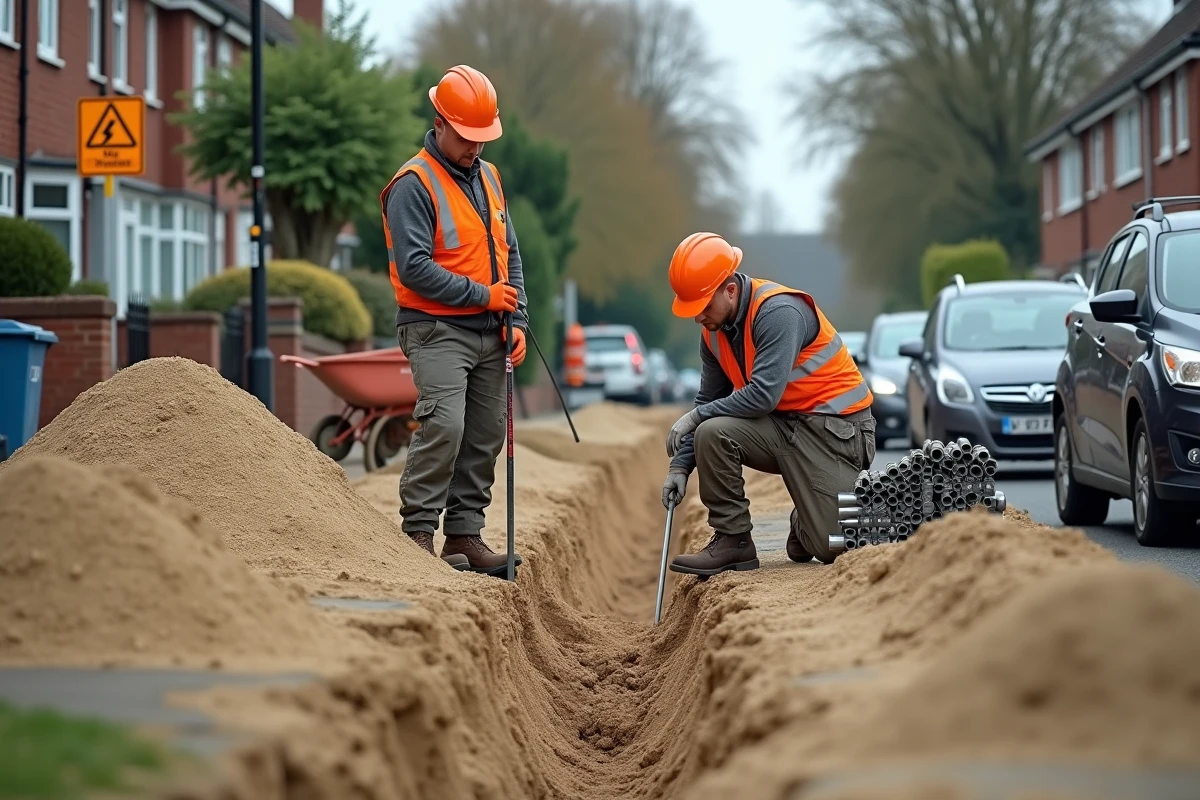
The quality of the implementation is as important as the quality of the material. Poorly compacted standardized sand does not protect better than makeshift backfill.
- Level the trench bottom to the specified height, removing any protruding elements (rock, roots, concrete debris) that could create a hard point under the bedding.
- Pour the sand in successive layers and compact it manually in layers of 10 to 15 cm, ensuring to properly fill the sides of the pipe (waist area) where voids are common.
- Place the warning mesh in the regulatory color (brown for sanitation, blue for drinking water, yellow for gas) before backfilling the upper part of the trench.
- Check the slope of the pipeline after compacting the bedding, as differential settlement of the sand can alter the gravitational flow of the network.
The most common mistake concerns the waist area of the pipe. Sand tends to form a natural arch above the pipe, leaving a lateral void. This void reduces the support surface and increases localized pressure. Hand-filling the sides of the pipe remains the only reliable method to eliminate this risk.
Another common mistake is using sand extracted from the site as coating material. If this sand has not been tested (presence of clay, organic matter, or stones), it does not meet the requirements of the NF EN 1610 standard and may be rejected during a compliance check.
The choice of sand and the rigor of its placement determine the lifespan of the buried network. A compliant coating, made with clean and compacted aggregate layer by layer, remains the best protection against mechanical disorders, whether the soil is stable or subject to climatic variations.